DSH Marketplace

opencode2dsh

FishBottle7/opencode2dsh

Exposes OpenCode Zen free models to DeepSeek Harness, with no API key.

38966TypeScriptMITSource

Install

Add opencode2dsh to DeepSeek Harness

Install into

via GitHub · GitHub source

Installing from GitHub runs the project's build script, which pnpm blocks until you allowlist it — run the command once and pnpm prints the exact key to add under `allowBuilds` in ~/.dsh/profiles/web/pnpm-workspace.yaml.

What happened when we ran it

Installed cleanly when we ran it

Every command here is run in a throwaway container against a clean profile, and the result is whatever the harness recorded — not a guess from the source. Last run 8d agoon DeepSeek Harness 0.2.2-rc.1.

Show it in your README

install verified — dshmarketplace

For maintainers: the badge serves this listing's latest sandbox verdict, so a re-run updates it on its own — and it links readers to the full result here.

Due diligence

Before you install opencode2dsh

  • Source of record: FishBottle7/opencode2dsh — present in the community registry that DSH's own plugin market installs from.
  • Licensed under MIT.

Security

What installing opencode2dsh runs

Build scripts

pnpm skipped these dependency build scripts, and the plugin registered without them:

  • @google/genai@1.52.0
  • protobufjs@7.6.6

Under pnpm 11 the install stops and asks you to approve them instead; an approved script runs with your user account's permissions.

Source: our sandbox install on DeepSeek Harness 0.2.2-rc.1, 8d ago.

Install hooks

package.json declares no preinstall, install or postinstall script.

Source: package.json on GitHub, read at our last sync. prepare is not recorded; it runs only on a GitHub install, and shows up under build scripts when pnpm blocks it.

README mentions

Neither shell commands nor credentials.

Source: a keyword match on the README — a hint about what the plugin touches, not an analysis of its code.

Not an audit. These are the record of one install and two text scans; nobody has read this plugin's code on your behalf. Plugins run with your agent's permissions.

The AI take

What it is — Registers native LlmAdapter exposing OpenCode Zen free models to DeepSeek Harness, no API key.

Who it is for — When using DeepSeek Harness in web profile to access OpenCode Zen free models it's suitable to install it. If using DSH below version 0.1.7, don't need to install it.

Watch out — Installation is from GitHub source code. Sandbox test passed: installed in new profile and registered in harness. No obvious pitfalls found.

The verdict — I would install it because it offers a native adapter with no extra process.

Generated by grok-4.6, and a starting point rather than a verdict. Where it says a plugin installs or does not, that is from a real run in a clean profile — everything else is read off the repository. Trust the source over this.

What opencode2dsh does

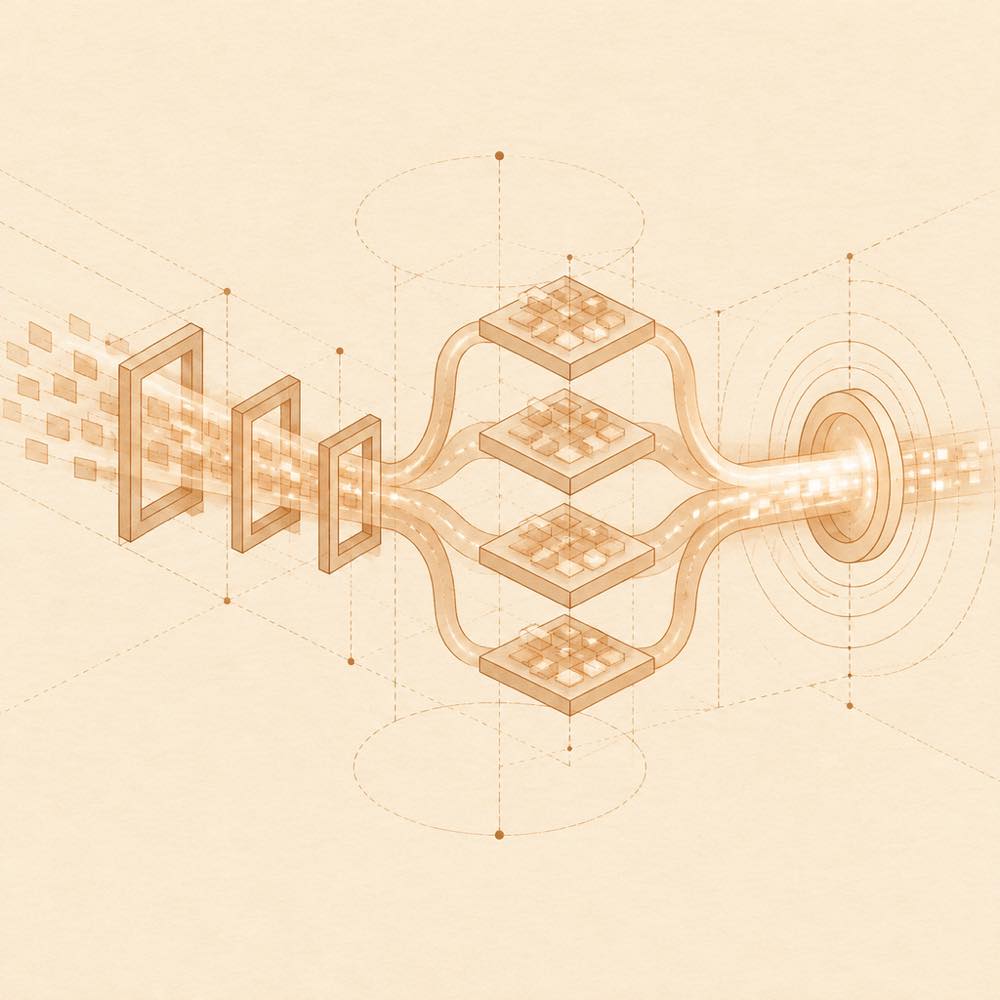
Abstract data streams pass through fallback layers and converge into one conduit.

opencode2dsh is a DeepSeek Harness plugin that exposes OpenCode Zen’s anonymous free models as a native provider without an API key or an additional process. DeepSeek Harness loads a native LlmAdapter from the npm package and presents eligible models under the opencode2dsh provider. The adapter streams chat models through pi-ai’s OpenAI-completions path and muse-spark-* models through its OpenAI-responses path, using HTTPS to https://opencode.ai/zen/v1.

The plugin reads the live model list from OpenCode Zen and model metadata from models.dev, intersecting that information with its free-model rules. It falls back to an offline cache and then a verified static list, refreshes the catalogue on a schedule, and writes a health snapshot for diagnostics. Requests include OpenCode CLI-style user-agent and correlation headers. Session and project identifiers are derived with SHA-256 from the conversation’s first user turn. allowedModels can narrow the models shown and called, while refreshSeconds controls catalogue refreshes.

opencode2dsh suits DeepSeek Harness installations that need the free OpenCode Zen lane and can provide outbound HTTPS to opencode.ai and models.dev. It is not a fit for environments without DeepSeek Harness 0.1.7 or newer, a web profile, or Node.js 20 or newer. The anonymous lane can also encounter an upstream credential gate; optional local OpenCode delegation exists for that case, but enabling it makes the plugin manage an opencode credential and run a local opencode serve process.

opencode2dsh documentation

Configuring opencode2dsh

DeepSeek Harness reads the plugin configuration from the profile’s cordis.patch.yml. The defaults are:

Key Default Function
mode adapter Uses the native adapter. sidecar is a legacy mode that requires an agent built from legacy/agent.
providerId opencode2dsh Provider name shown in DeepSeek Harness.
refreshSeconds 300 Live catalogue refresh interval. Pricing metadata refreshes every 24 hours.
allowedModels [] Adapter-mode whitelist of exact model IDs. An empty list exposes eligible free-lane models.
firstEventMs 30000 Adapter stream watchdog for the first event.
bodyIdleMs 120000 Adapter watchdog for mid-response body silence.
responsesBodyIdleMs 300000 Body-idle limit for muse-spark-* Responses models.

The watchdog values accept integers from 1 to 600000. Changes require restarting DeepSeek Harness. Sidecar-only keys include agentPath, agentArgs, restartDelayMs, restartMaxDelayMs, and maxConsecutiveCrashes.

Requirements for opencode2dsh

DeepSeek Harness must be version 0.1.7 or newer and use a web profile. The runtime requires Node.js 20 or newer, with outbound HTTPS access to opencode.ai and models.dev.

How opencode2dsh behaves

The adapter registers a native LlmAdapter and streams harness events, including text deltas, usage, and finish events. Chat models use OpenAI-completions streaming; muse-spark-* models use OpenAI-responses streaming. The catalogue uses the live upstream list, an offline cache, and a verified static list in fallback order. The plugin periodically refreshes it and writes a health snapshot.

Delegation and limits

Delegation is disabled by default. With delegation.enabled: true, the plugin may seed only the opencode credential into an isolated XDG root and start a managed local opencode serve after anonymous requests and a sibling retry receive the persistent 403 FreeTierError credential gate. Read docs/delegation.md before enabling this option.

Written from the project's own documentation and kept in sync with it. Where the two disagree, the source is authoritative — read the README on GitHub

Same category

Alternatives to opencode2dsh

54k

Adds free model lanes to DeepSeek Harness — DeepSeek V4.1 Flash, Kimi K3 and others — with no login, sign-up or API key, plus a local OpenAI-compatible gateway, fallback routing and a usage dashboard.

Installed cleanly when we ran it

GitHub sourceJavaScript14d ago

AI review

dsh-our-free-model

What it is — Wires unpaid model lanes, a localhost OpenAI-compatible gateway, named fallback chains, and an on-machine usage dashboard into DeepSeek Harness.

Who it is for — You are in DeepSeek Harness shipping code or running an agent with no API key, and you need DeepSeek V4.1 Flash or Kimi K3 on the selector—or the same models exposed on localhost for other clients. Skip it where policy allows only private or leased-line egress; the unpaid lanes talk to the OpenCode Zen and Kilo public gateways.

Watch out — Reachability is whatever your machine’s egress actually gets; geo-blocked ids land in a region-limited group, while 5xx, 429, and timeouts do not drop a model from the picker. Kilo’s free pool states prompts may be logged. Marked beta, listed for dsh 0.1.5–0.1.7-rc.2. A clean-profile sandbox install registered with the harness. It invokes the shell.

The verdict — Install it, drive day-to-day traffic through keys in the bundled provider registry, and leave the free pool at the tail of a fallback chain.

Generated by grok-4.6, and a starting point rather than a verdict. Where it says a plugin installs or does not, that is from a real run in a clean profile — everything else is read off the repository. Trust the source over this.Read the source
1Details

dsh-our-free-model

zouyuxuan122

25k

在 dsh 里装上这个插件即可,无需登录、注册或填 API Key,就能使用包括 Muse Spark 1.3、MiMo V2.6 在内的前沿模型——完全免费,不限量。 All you do is install this plugin in dsh: no login, no sign-up, no API key — the frontier models are just there, Muse Spark 1.3 and MiMo V2.6 among them. Completely free, with no usage cap.

Installed cleanly when we ran it

GitHub sourceJavaScript27d ago

AI review

dsh-our-free-model

What it is — Mounts upstream-refreshed model lanes into DeepSeek Harness and exposes a local OpenAI- and Anthropic-compatible proxy.

Who it is for — You are running agent work inside DeepSeek Harness, want DeepSeek V4.1 Flash or MiMo V2.6 in the current session picker, and have no provider key. If the host already talks to a company gateway through one Base URL, a second local proxy is a duplicate hop.

Watch out — In a clean profile it installed and the harness registered it. What you can call depends on this machine's egress; region-blocked models go into a limited group, and the Kilo pool says prompts may be logged. It executes shell commands; the desktop EAC lane also needs GitHub authorization. Docs list dsh 0.1.5 through 0.1.7-rc.2, status beta.

The verdict — I would keep it as a scratch lane, not the production default — the free quota sits upstream, and this plugin cannot promise it will still be there tomorrow.

Generated by grok-4.6, and a starting point rather than a verdict. Where it says a plugin installs or does not, that is from a real run in a clean profile — everything else is read off the repository. Trust the source over this.Read the source
1Source

dsh-purge

HunYiSage

17k

DeepSeek Harness 破甲:让所有模型都能破甲,不同模型可换不同提示词;默认提示词面向国模「小码酱」。Jailbreak for every model — swap prompts per model. 求 Star 收藏 ⭐ 如要二开,请查看署名要求部分

Installed cleanly when we ran it

GitHub sourceJavaScript11d ago

AI review

dsh-purge

What it is — dsh-purge is a DeepSeek Harness plugin that separates prompt rewriting from sandbox policies and allows swapping prompts per model.

Who it is for — In local lab security evaluations using DeepSeek Harness, users needing to separate prompt rewriting from sandbox policies are suitable for installing it. Users not performing local configuration modifications do not need to install it.

Watch out — Installation requires providing an API key or token and will execute shell commands. Sandbox testing passed in a fresh profile with no obvious issues found.

The verdict — If conducting local lab red-team assessments on Harness security configs, I would install it because it separates prompt and sandbox layers for controlled testing.

Generated by grok-4.6, and a starting point rather than a verdict. Where it says a plugin installs or does not, that is from a real run in a clean profile — everything else is read off the repository. Trust the source over this.Read the source
3Source
1.2k

Connects locally signed-in WorkBuddy models, CN and international alike, to DSH, reading each model's credit multiplier from the upstream catalog on every refresh, with per-model image input toggles, account switching backed by an auto-failing-over pool, manual daily check-in, and read-only credit overviews shown as compact pills on the card and in the composer.

Installed cleanly when we ran it

npm packageTypeScript8d ago

AI review

dsh-connect-workbuddy

What it is — Registers locally signed-in WorkBuddy (CN and global) as DSH providers and refreshes each model's credit multiplier from upstream.

Who it is for — You already have a WorkBuddy login on the machine and you are doing coding work in DSH, but GLM-5.3, DeepSeek-V4-Pro, or GPT-5.6 still cannot be chosen there. Skip it if the official WorkBuddy app is where that account should be used, and DSH is not the place those models should appear.

Watch out — WorkBuddy is already limiting unofficial client traffic, so the bridge can stop when upstream tightens, and long-term API availability is not promised. Calls spend your own credits; the plugin does not change account state, and it does run shell commands. A clean-profile install succeeded and was registered into that profile.

The verdict — I'd add it as a part I can delete overnight—only if those models never become a load-bearing step.

Generated by grok-4.6, and a starting point rather than a verdict. Where it says a plugin installs or does not, that is from a real run in a clean profile — everything else is read off the repository. Trust the source over this.Read the source
1Details

agy-staff

keli-wen

868

Hire Google's Antigravity CLI (agy) as a fast Gemini staffer for Claude Code, OpenAI Codex, and DeepSeek Harness.

Installed cleanly when we ran it

GitHub sourceJavaScript2d ago

AI review

agy-staff

What it is — Integrate Antigravity CLI agy as staffer, supporting Gemini 4 models and orchestration modes.

Who it is for — Use agy as subagent for research and code review tasks in Claude Code. Do not use it for real-time interactive tasks because agy acts as a background worker that waits for the agy job to finish.

Watch out — It requires installing Antigravity CLI first. It will execute shell commands. Benchmark results show task time increasing from 2-8 minutes to 13-26 minutes.

The verdict — I would install it because it can reduce host token spend on research tasks, though it increases task completion time.

Generated by grok-4.6, and a starting point rather than a verdict. Where it says a plugin installs or does not, that is from a real run in a clean profile — everything else is read off the repository. Trust the source over this.Read the source
1Source

Use ChatGPT (Codex), Claude, and Grok subscriptions as DeepSeek Harness LLM providers, with Settings login, model catalogs, usage, plus image_generate, video_generate, and x_search tools.

Installed cleanly when we ran it

npm packageTypeScript19d ago

AI review

dsh-plugin-subscriptions

What it is — This plugin allows DeepSeek Harness to use ChatGPT (Codex), Claude, Grok, GitHub Copilot, and Google Antigravity subscriptions as LLM providers.

Who it is for — When you want to use Claude or Grok models in DeepSeek Harness for conversations, you can install this plugin. If you need to manage other API keys or tokens, this plugin is not suitable because it focuses on subscription services' login and management.

Watch out — In sandbox test, installation succeeded in a new profile and it was registered by harness. It requires providing an API key or token. No obvious issues were found.

The verdict — I would install it because it succeeded in sandbox testing and registered to the profile, providing a reliable usage method.

Generated by grok-4.6, and a starting point rather than a verdict. Where it says a plugin installs or does not, that is from a real run in a clean profile — everything else is read off the repository. Trust the source over this.Read the source
1Details