DSH Marketplace

dsh-undo-plugin

lire1131/dsh-undo-plugin

Undo/redo & rollback system for DSH: every config change is auto-snapshotted; undo/redo/restore to any version from the WebUI or the offline CLI/GUI tools (works even when DSH fails to boot).

703JavaScriptMITSource

Install

Add dsh-undo-plugin to DeepSeek Harness

via GitHub · GitHub source

Installing from GitHub runs the project's build script, which pnpm blocks until you allowlist it — run the command once and pnpm prints the exact key to add under `allowBuilds` in ~/.dsh/profiles/web/pnpm-workspace.yaml.

What happened when we ran it

Installed cleanly when we ran it

Every command here is run in a throwaway container against a clean profile, and the result is whatever the harness recorded — not a guess from the source. Last run yesterday.

Due diligence

Before you install dsh-undo-plugin

  • Source of record: lire1131/dsh-undo-plugin — present in the community registry that DSH's own plugin market installs from.
  • Licensed under MIT.
  • Detected: terminal surface. Read the source before granting these.
  • A listing here is not a security review. Plugins run with your agent's permissions.

The AI take

What it is — Provide snapshot and rollback functionality for DeepSeek Harness configuration and plugin code, with one-click reversion to any version via WebUI, CLI or offline GUI.

Who it is for — When frequently adjusting profile settings or plugin code in the DeepSeek Harness WebUI, this is suitable. It is not appropriate for users running simple local scripts only, as the plugin targets DeepSeek Harness configuration management.

Watch out — Tested successfully after installation into a fresh profile with harness registration. Static check indicates shell command execution. No obvious issues found.

The verdict — I would install it, as it handles offline recovery when DeepSeek Harness fails to boot, without requiring additional dependencies.

Generated by grok-4.6, and a starting point rather than a verdict. Where it says a plugin installs or does not, that is from a real run in a clean profile — everything else is read off the repository. Trust the source over this.

What dsh-undo-plugin does

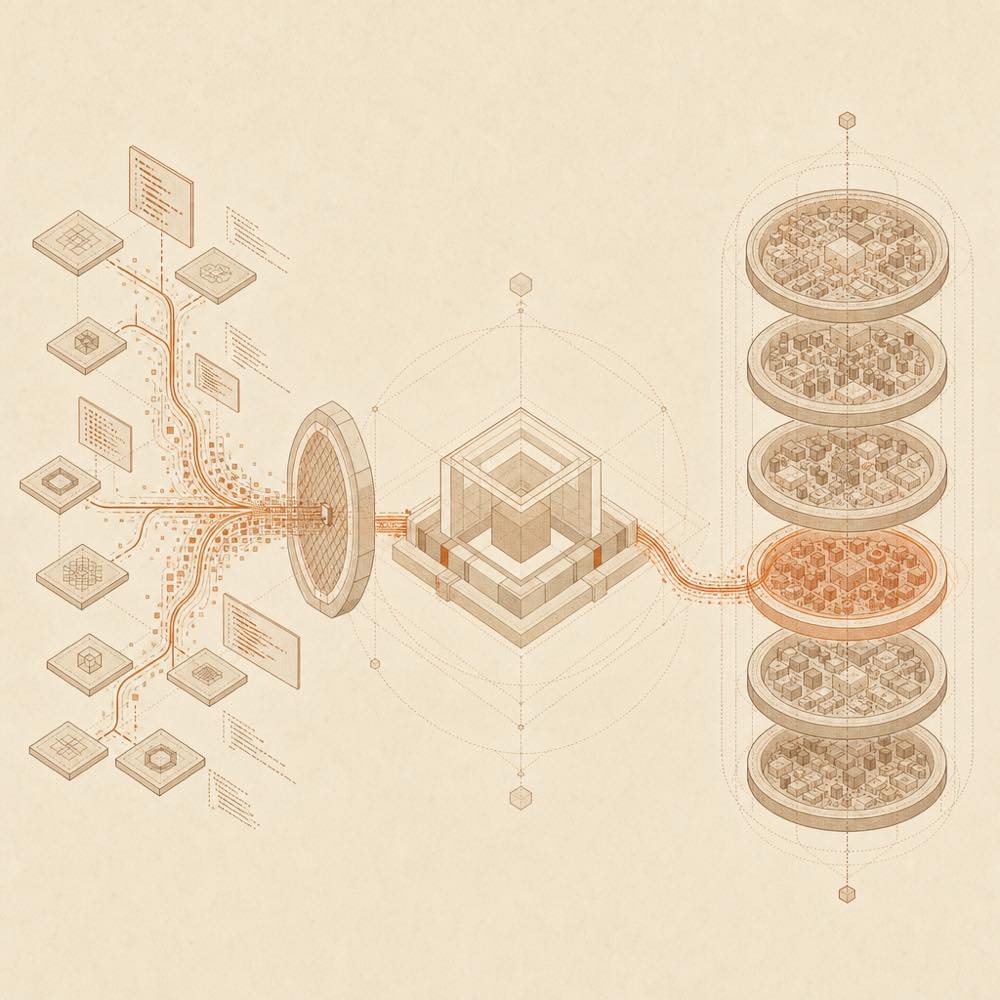
Configuration tiles and code fragments flow into layered archives, with one version restored through a protective gate.

dsh-undo-plugin is a DeepSeek Harness plugin that snapshots configuration changes and provides undo, redo and version rollback through the WebUI and offline tools. It is intended for recovering from broken configuration or user plugin code, including cases where DSH no longer starts.

The plugin watches the DSH configuration and plugin-code locations used by the profile, then writes automatic or manual snapshots to a snapshot repository. The documented snapshot set includes cordis.patch.yml, package.json, cordis.yml, pnpm-workspace.yaml, settings.yaml and .env, plus the user plugin code tree. It stores real secret values in a local vault while redacting .env and credential data in snapshots and exported ZIP files. Available operations include snapshot, restore -Id <id>, remove -Id <id>, recent and safe-mode -Label on; WebUI controls and offline CLI/GUI tools provide additional access.

This DeepSeek Harness plugin is for developers who want a recoverable history for DSH settings and installed plugin changes, particularly when testing configuration or plugin code. It is a poor fit where storing local copies of configuration is unacceptable, or where DSH and Node.js are not already available. The plugin reaches configuration files, .env, plugin code and the local snapshot/vault directories, and its terminal surface can invoke recovery actions with the agent’s permissions. Snapshots may contain configuration copies, so exports require care.

dsh-undo-plugin documentation

How it behaves

Configuration changes are automatically snapshotted. Manual snapshots can be created from the WebUI, conversation commands or the CLI. Automatic storage keeps the most recent 20 files; manual snapshots are not automatically cleaned. Undo creates a redo or “regret” snapshot. Restoring plugin or mount-related changes may require restarting DSH. After an abnormal exit, the WebUI and GUI can identify the last-good snapshot. Before restoration, the plugin checks for missing plugins and reports them.

The snapshot covers these files and the user plugin code tree:

Location Files
DSH profile cordis.patch.yml, package.json, cordis.yml, pnpm-workspace.yaml
$DSH_HOME settings.yaml, .env
Plugin files User plugin code tree

.env and credential data are redacted in snapshots and exported ZIP files. Actual values are kept in a local vault so a local rollback can restore them.

Commands

The documented CLI operations include:

  • snapshot — create a manual snapshot.
  • restore -Id <id> — restore a selected snapshot.
  • remove -Id <id> — delete a snapshot.
  • recent — view recent rollback records.
  • safe-mode -Label on — enable safe mode when DSH cannot boot.

The WebUI and offline GUI also provide undo, redo, rollback, deletion, import and export. Conversation commands include undo, undo_recent, “保存快照” and “回退到 <id>”.

Configuration and paths

The current profile is detected from dsh --profile mine or --profile=mine; dsh web falls back to web. Offline tools use DSH_UNDO_PROFILE or profileName, defaulting to web.

Setting Default or behaviour
DSH_HOME The DSH data home; otherwise the user home .dsh directory
profileDir The current profile directory
manualDir Manual snapshot repository
autoDir Automatic snapshot repository
profileName Profile name; offline default is web
DSH_UNDO_SETTINGS Explicit settings-file override
DSH_UNDO_ROOT Explicit snapshot-root override
DSH_UNDO_EXPORT Explicit export-path override

By default, settings are stored at $DSH_HOME/undo/settings.json, snapshots at $DSH_HOME/undo-snapshots/<profile>/{auto,manual}, and profiles at $DSH_HOME/profiles/<profile>. Explicit environment variables and configuration paths take precedence.

Requirements and recovery mode

The README requires DSH (@deepseek-ai/dsh) and Node.js ≥20. Safe mode disables every plugin except the undo system, saves a configuration backup, and can later be exited. The offline GUI and CLI are installed inside the plugin’s tools directory rather than on the desktop; the README documents .bat launchers and Windows paths.

Written from the project's own documentation and kept in sync with it. Where the two disagree, the source is authoritative — read the README on GitHub

Same category

Alternatives to dsh-undo-plugin

treg

superdesigndev

452

Tool catalog for agents: search ~2,600 external endpoints (SEO and SERP, backlinks, social, people and company enrichment, ad libraries, scraping) by the task you want done, read each one's parameters and per-call price, then call it with the credential injected server-side. Ships the skill plus an MCP row that stays disabled until TREG_TOKEN is set.

Installed cleanly when we ran it

GitHub sourcePythonyesterday

AI review

treg

What it is — The treg plugin provides DeepSeek Harness agents with a tool catalog to search and call approximately 2600 external endpoints by task.

Who it is for — When using a DeepSeek Harness agent to perform data collection tasks requiring external tools without managing multiple vendor accounts, this plugin is suitable. Developers who only use local CLIs or self-built skills can from another angle achieve the needed functionality through direct configuration.

Watch out — Sandbox test passed: installed in a fresh profile and registered into the profile by Harness. No obvious pits found. Source installation requires manually allowing the build script.

The verdict — I would install it because it enables a DeepSeek Harness agent to access external tools with one token and server-side credential injection.

Generated by grok-4.6, and a starting point rather than a verdict. Where it says a plugin installs or does not, that is from a real run in a clean profile — everything else is read off the repository. Trust the source over this.Read the source
1Details
252

Chrome sidebar extension that lets DSH operate your browser directly, no vision capabilities required.

Installed cleanly when we ran it

GitHub sourceTypeScriptyesterday

AI review

dsh-browser

What it is — A Chrome sidebar extension that lets DSH operate your browser directly without vision capabilities.

Who it is for — When you want the model to operate in your actual browser to fill forms or navigate while preserving login state, you can use this plugin. It registers the DSH bundle in the web profile. If you only run DSH in terminal without browser control needs, you can skip this plugin.

Watch out — Installation requires manual approval of the build script from source. Sandbox testing passed, it registers in a fresh profile.

The verdict — I would install it because it enables model operation in a real browser session with preserved state.

Generated by grok-4.6, and a starting point rather than a verdict. Where it says a plugin installs or does not, that is from a real run in a clean profile — everything else is read off the repository. Trust the source over this.Read the source
1Details

notes

zhaoolee

144

Export DSH conversations as Smartisan Notes-style PNGs, or create and update Markdown notes in a configured account-scoped workspace.

Installed cleanly when we ran it

GitHub sourceTypeScriptyesterday

AI review

notes

What it is — Export DSH conversations to Smartisan Notes-style PNGs or create and update Markdown notes in an account-scoped workspace.

Who it is for — Users who want to organize conversation records with DeepSeek Harness and export them as notes for sharing are suitable for installing this plugin. If you mainly handle static documents rather than conversation records, you can skip installing this plugin.

Watch out — Successfully registered in the profile after installation. No obvious issues found.

The verdict — I would install it because it allows direct export of conversations into notes with a simple trigger in the DSH dialogue.

Generated by grok-4.6, and a starting point rather than a verdict. Where it says a plugin installs or does not, that is from a real run in a clean profile — everything else is read off the repository. Trust the source over this.Read the source
1Details

modsearch

liustack

133

Web search bridge for text-only agents: ask the web or X, get structured JSON evidence (search, fetch, citations).

Installed cleanly when we ran it

npm packageTypeScriptyesterday

AI review

modsearch

What it is — ModSearch provides web search, X search, and page fetching capabilities for text models in DeepSeek Harness.

Who it is for — When using DeepSeek-V4-Flash for tasks requiring up-to-date information, it supplements web search capabilities. If you use a model with native web access, it is not needed.

Watch out — Installation requires browser login for the default engine or free API keys from alternatives. Sandbox test passed: works in fresh profile and registered. The plugin executes shell commands. No obvious issues found.

The verdict — I would install it because of the free default engine and automatic failover support.

Generated by grok-4.6, and a starting point rather than a verdict. Where it says a plugin installs or does not, that is from a real run in a clean profile — everything else is read off the repository. Trust the source over this.Read the source
1Details

argo

taxueseek

98

Search built for agents: multilingual coverage across web, academic, code, shopping, finance, news, and encyclopedias.

Installs, but not as a profile layer

npm packagePython5d ago

AI review

argo

What it is — Argo is a multilingual search infrastructure for AI agents, delivering structured evidence candidates with credibility decomposition.

Who it is for — If you are developing AI agents using DeepSeek Harness to query topics like finance, sports, or movies requiring structured evidence support, it fits. If you seek only human-readable search summaries or link lists, you do not need it.

Watch out — Successfully installed via command, but treated as ordinary dependency without dsh.bundle so no profile layer added. No obvious issues found in sandbox testing.

The verdict — I would install it because it offers structured evidence for agents to reduce context bloat and costs, but as an ordinary dependency it will not add a profile layer and must be used as per its documentation.

Generated by grok-4.6, and a starting point rather than a verdict. Where it says a plugin installs or does not, that is from a real run in a clean profile — everything else is read off the repository. Trust the source over this.Read the source
1Details

ru-marketplace-mcp

Vladimir-Human

64

Skills and optional MCP rows for ten Russian marketplaces: price comparison across Wildberries, Detsky Mir and Yandex Market, plus per-source search, product cards and reviews. The 13 skills load on install; both MCP rows stay disabled until RU_MARKETPLACE_MCP_DIR points at a local clone, which needs Python 3.12+ and uv.

No one-line install — this plugin lives inside a larger repository and publishes no npm package.

GitHub sourcePythonyesterday

AI review

ru-marketplace-mcp

What it is — ru-marketplace-mcp integrates Russian marketplace plugins for DeepSeek Harness.

Who it is for — If you need Russian marketplace product information in DeepSeek Harness, install this plugin. If you prefer plugins that work completely offline, you don't need to install this one.

Watch out — It requires Python 3.12+ and uv. Some features require your logged-in Chrome. No obvious pitfalls found.

The verdict — If I were you, I would install it because the sandbox has not been tested.

Generated by grok-4.6, and a starting point rather than a verdict. Where it says a plugin installs or does not, that is from a real run in a clean profile — everything else is read off the repository. Trust the source over this.Read the source
1Details