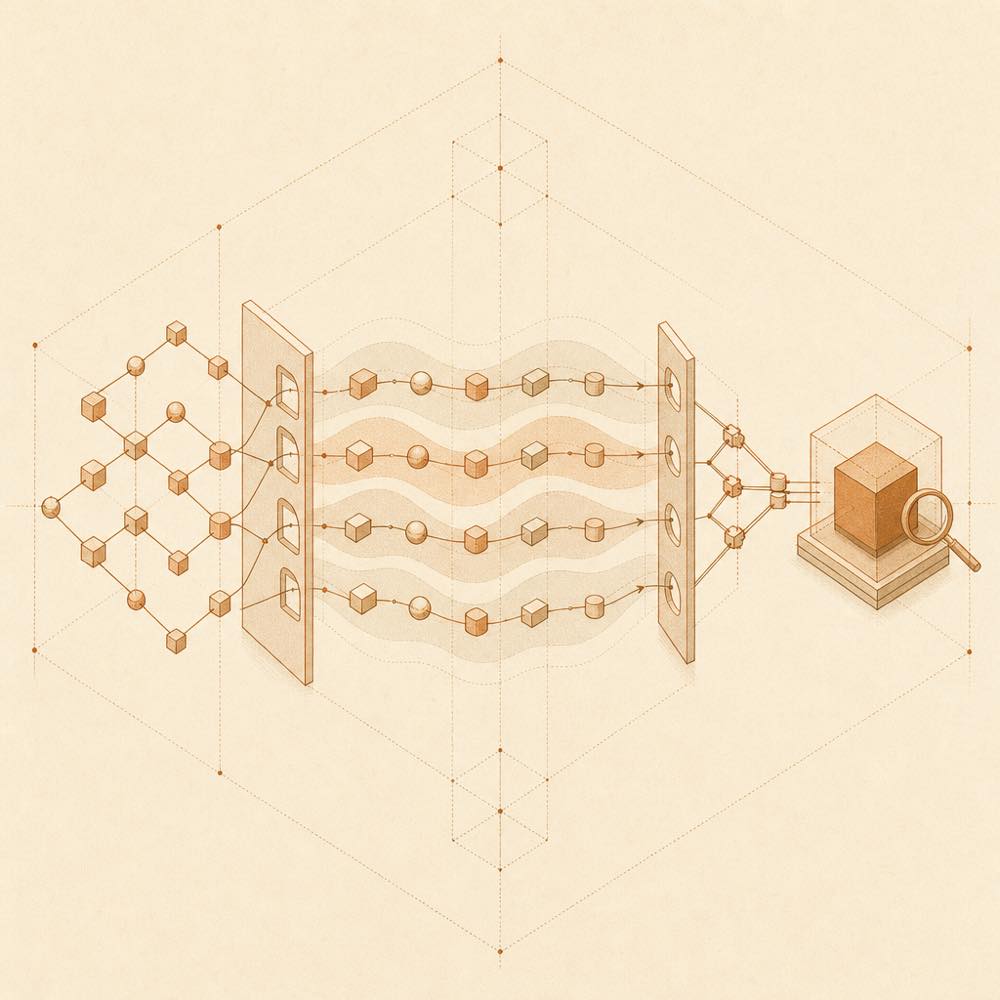
agent_team_gui
toolclub/agent_team_gui
Reusable agent squads with per-agent provider/model routes and tool policies, serial/parallel dispatch, spawn/fork/chain context modes, and a Web management panel.
Install
Add agent_team_gui to DeepSeek Harness
via GitHub · GitHub source
Installing from GitHub runs the project's build script, which pnpm blocks until you allowlist it — run the command once and pnpm prints the exact key to add under `allowBuilds` in ~/.dsh/profiles/web/pnpm-workspace.yaml.
What happened when we ran it
Installs, but needs a build approved first
pnpm refuses to run a package's build script until it is allowlisted. Add the key pnpm prints to allowBuilds in the profile's pnpm-workspace.yaml, then run the command again.
Every command here is run in a throwaway container against a clean profile, and the result is whatever the harness recorded — not a guess from the source. Last run yesterday.
Due diligence
Before you install agent_team_gui
- Source of record: toolclub/agent_team_gui — present in the community registry that DSH's own plugin market installs from.
- Licensed under MIT.
- Detected: terminal surface. Read the source before granting these.
- A listing here is not a security review. Plugins run with your agent's permissions.
The AI take
What it is — This plugin allows creating and managing persistent multi-model agent teams in DeepSeek Harness.
Who it is for — If you need to handle complex tasks in DeepSeek Harness using multi-model agent teams with different models and tool policies, this plugin provides per-agent routing and tool policies. Users without any configured DSH provider/model routes cannot use it because the plugin requires at least one configured route.
Watch out — Installing from source requires manually allowing the build script, otherwise registration cannot be completed. No other obvious issues were found.
The verdict — I would install it, provided the build script is manually allowed, because it enables persistent multi-model team management as a reusable object.
Generated by grok-4.6, and a starting point rather than a verdict. Where it says a plugin installs or does not, that is from a real run in a clean profile — everything else is read off the repository. Trust the source over this.
What agent_team_gui does

agent_team_gui is a DeepSeek Harness plugin that runs reusable teams of agents with separate model routes, role prompts, fallback routes, token limits, and tool policies.
DeepSeek Harness loads the plugin in the Web profile and adds team controls beside the normal composer. A selected team responds to eligible top-level messages according to its activation and conversation mode. With fixed order disabled, a bounded, tool-free planner uses the active conversation's provider/model route, member roles, and the current request to produce structured assignments and an acyclic dependency graph. Ready members run in waves up to maxConcurrency; dependent members receive bounded structured handoffs, while full outputs, stages, retries, errors, timings, review rounds, and official token coverage are kept in durable run history. A fixed member order uses serial dispatch instead. Teams and members are managed in Settings → Members and Settings → Teams, and configuration can be checked with dsh --profile web --dump-config.
This is intended for developers who need repeatable multi-agent workflows across conversations and projects, with per-member permissions and observable runs. It is a poor fit for a single-agent task, or for environments without the Web profile, a supported Node.js version, and at least one configured provider/model route. The plugin also adds a terminal surface: any terminal-capable tool granted to a team member can be reached during that member's run, so member tool policies determine the resulting access.
agent_team_gui documentation
Configuring agent_team_gui
DeepSeek Harness loads agent_team_gui in the web profile. Members are created in Settings → Members with a provider/model route, role prompt, optional fallback route, token limit, and selected tools. Teams are created in Settings → Teams from those members. Team settings include activation (Always, Smart, or Manual), member selection (All members or Adaptive), foreground or background response, fixed ordering, and optional resilience, budget, and review controls. The README names maxConcurrency as the limit for concurrently runnable DAG nodes.
Conversation selection supports Team, Solo, and Inherited. A team can be queued for the Next message, while a project default can supply the inherited selection. These states survive refresh, cold Host startup, and live reconnect.
Commands and verification
DeepSeek Harness starts the Web profile with:
dsh --profile web
To inspect the composed bundle without installing rg, run:
dsh --profile web --dump-config | grep -E "agent-team-gui|dsh-agent-team-gui"
The output should contain the dsh-agent-team-gui bundle layer and the agent-team-gui row. If dsh is not on PATH, the README documents the equivalent pnpm dsh --version form from a Harness checkout and a pnpm --dir /absolute/path/to/deepseek-harness dsh ... prefix for commands.
Requirements for agent_team_gui
DeepSeek Harness must be >=0.1.0-rc.5 <0.2.0, with the Web profile enabled. Supported Node.js versions are >=22.19.0 <23 or >=24.0.0; Node.js 23 is unsupported. The README also requires pnpm and at least one configured DSH provider/model route.
Git dependencies run the repository's prepare build. With pnpm 10 or later, that build may require allowBuilds: dsh-agent-team-gui: true in ~/.dsh/profiles/web/pnpm-workspace.yaml. Restart an existing DeepSeek Harness Web process after installation or an update.
How agent_team_gui behaves
Without a fixed order, the planner returns assignments and an acyclic graph; invalid, cyclic, or unavailable plans fall back to deterministic role-scoped assignments. Dependants receive bounded structured handoffs, not the complete preceding output. An optional quality gate can request up to two repairs from a named repair owner. Team runs expose plans, stages, outputs, errors, timings, retries, review or repair rounds, and official token coverage.
Written from the project's own documentation and kept in sync with it. Where the two disagree, the source is authoritative — read the README on GitHub
Same category
Alternatives to agent_team_gui
dsh-plugin
Tabbit-Browser
Tabbit Broser plugins for Deepseek Harness
Installed cleanly when we ran it
dsh_workflow
icetomoyo
UltraCode-style multi-agent orchestration: a generatable, savable, governable, observable, resumable workflow layer.
Installed cleanly when we ran it
dsh-automation
titanwings
Scheduled coding runs in fresh agent sessions with auditable history.
Installed cleanly when we ran it
mstar-harness
btspoony
Skill-driven harness/loop engineering workflow agent plugin.
Installed cleanly when we ran it
dsh-agent-team-gui
toolclub
Global persistent agent squads with per-agent model/tool policies: manage them in Settings, select and toggle one per conversation, then collaborate on normal sends in a fixed or model-planned order.
Installs, but needs a build approved first